Dec 3, 2025
Dec 3, 2025
Dec 3, 2025
Chanel Métiers d’Art 2026 – An Urban Symphony of Savoir-Faire in New York
Chanel Métiers d’Art 2026 – An Urban Symphony of Savoir-Faire in New York
Chanel Métiers d’Art 2026 – An Urban Symphony of Savoir-Faire in New York
Fashion
Fashion
Fashion
Chanel Métiers d’Art 2026 – An Urban Symphony of Savoir-Faire in New York
Chanel Métiers d’Art 2026 – An Urban Symphony of Savoir-Faire in New York
Chanel Métiers d’Art 2026 – An Urban Symphony of Savoir-Faire in New York
by
by
by
L’essence Studios Editorial HQ
L’essence Studios Editorial HQ
L’essence Studios Editorial HQ
Courtesy of Chanel.
Courtesy of Chanel.
Courtesy of Chanel.
Dec 3, 2025
Dec 3, 2025
Dec 3, 2025
Chanel’s annual Métiers d’Art show – a traveling showcase of demi-couture-level craftsmanship – made a grand return to New York City this past week. The highly anticipated event, held at an abandoned downtown subway station, marked the first Chanel show in New York since Karl Lagerfeld’s 2018 Métiers d’Art presentation at the Met’s Temple of Dendur. It also marked the sophomore collection for Chanel’s new artistic director, Matthieu Blazy, and his very first Métiers d’Art outing for the House. Each year since 2002, Chanel has hosted a Métiers d’Art spectacle in a different city, conceived to celebrate and preserve the work of the House’s artisan ateliers. Blazy embraced this mandate with zeal: “It needs to demonstrate know-how,” he has said of the Métiers tradition. Accordingly, the New York show was a sumptuous homage to Chanel’s 11 specialized Métiers d’Art craft studios that are united at the le19M hub in Paris, all while weaving a love letter to The Big Apple’s inimitable and kaleidoscopic spirit.
Chanel’s annual Métiers d’Art show – a traveling showcase of demi-couture-level craftsmanship – made a grand return to New York City this past week. The highly anticipated event, held at an abandoned downtown subway station, marked the first Chanel show in New York since Karl Lagerfeld’s 2018 Métiers d’Art presentation at the Met’s Temple of Dendur. It also marked the sophomore collection for Chanel’s new artistic director, Matthieu Blazy, and his very first Métiers d’Art outing for the House. Each year since 2002, Chanel has hosted a Métiers d’Art spectacle in a different city, conceived to celebrate and preserve the work of the House’s artisan ateliers. Blazy embraced this mandate with zeal: “It needs to demonstrate know-how,” he has said of the Métiers tradition. Accordingly, the New York show was a sumptuous homage to Chanel’s 11 specialized Métiers d’Art craft studios that are united at the le19M hub in Paris, all while weaving a love letter to The Big Apple’s inimitable and kaleidoscopic spirit.
Chanel’s annual Métiers d’Art show – a traveling showcase of demi-couture-level craftsmanship – made a grand return to New York City this past week. The highly anticipated event, held at an abandoned downtown subway station, marked the first Chanel show in New York since Karl Lagerfeld’s 2018 Métiers d’Art presentation at the Met’s Temple of Dendur. It also marked the sophomore collection for Chanel’s new artistic director, Matthieu Blazy, and his very first Métiers d’Art outing for the House. Each year since 2002, Chanel has hosted a Métiers d’Art spectacle in a different city, conceived to celebrate and preserve the work of the House’s artisan ateliers. Blazy embraced this mandate with zeal: “It needs to demonstrate know-how,” he has said of the Métiers tradition. Accordingly, the New York show was a sumptuous homage to Chanel’s 11 specialized Métiers d’Art craft studios that are united at the le19M hub in Paris, all while weaving a love letter to The Big Apple’s inimitable and kaleidoscopic spirit.
Share
New York Underground as Stage and Story
New York Underground as Stage and Story
New York Underground as Stage and Story
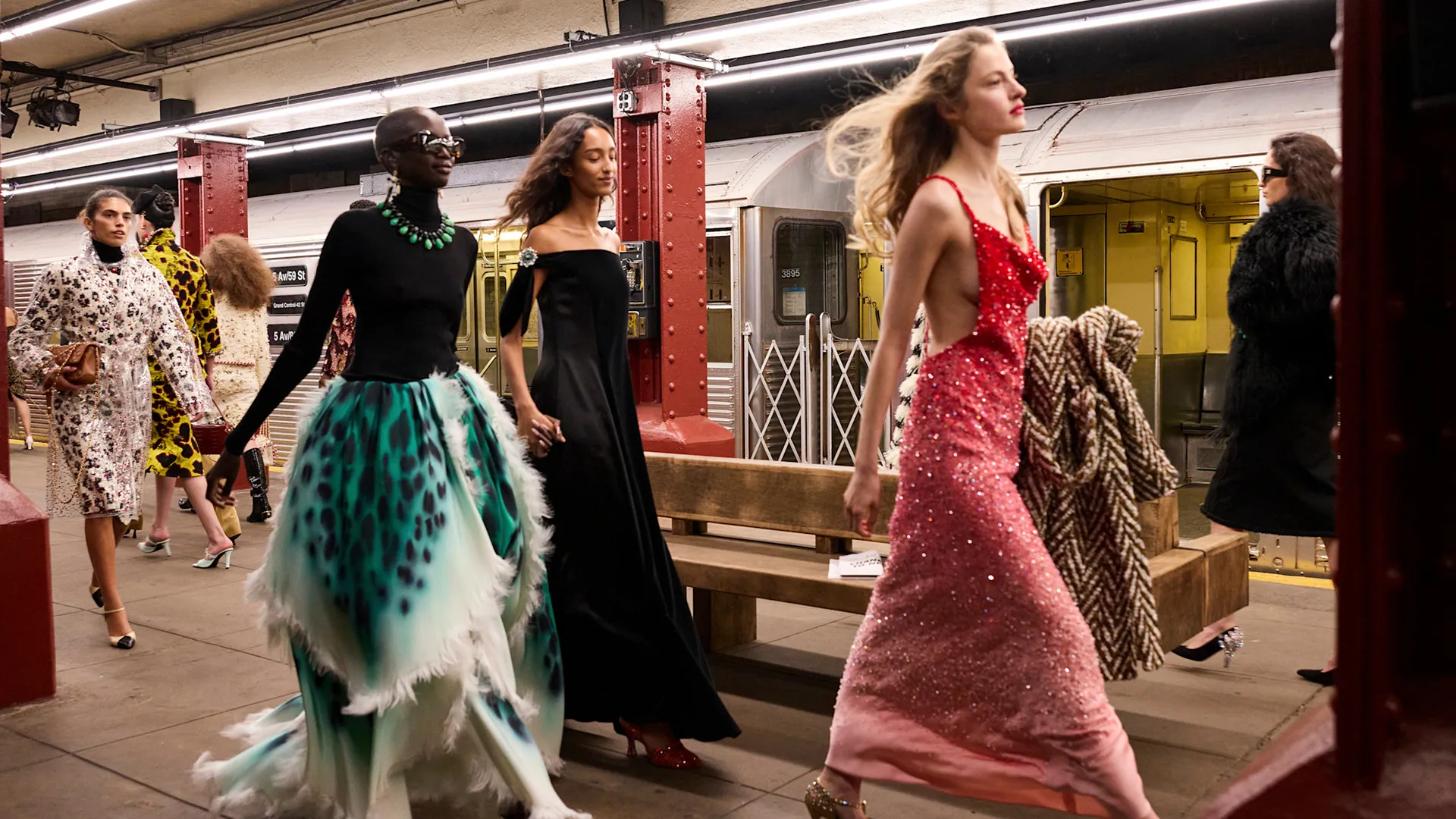
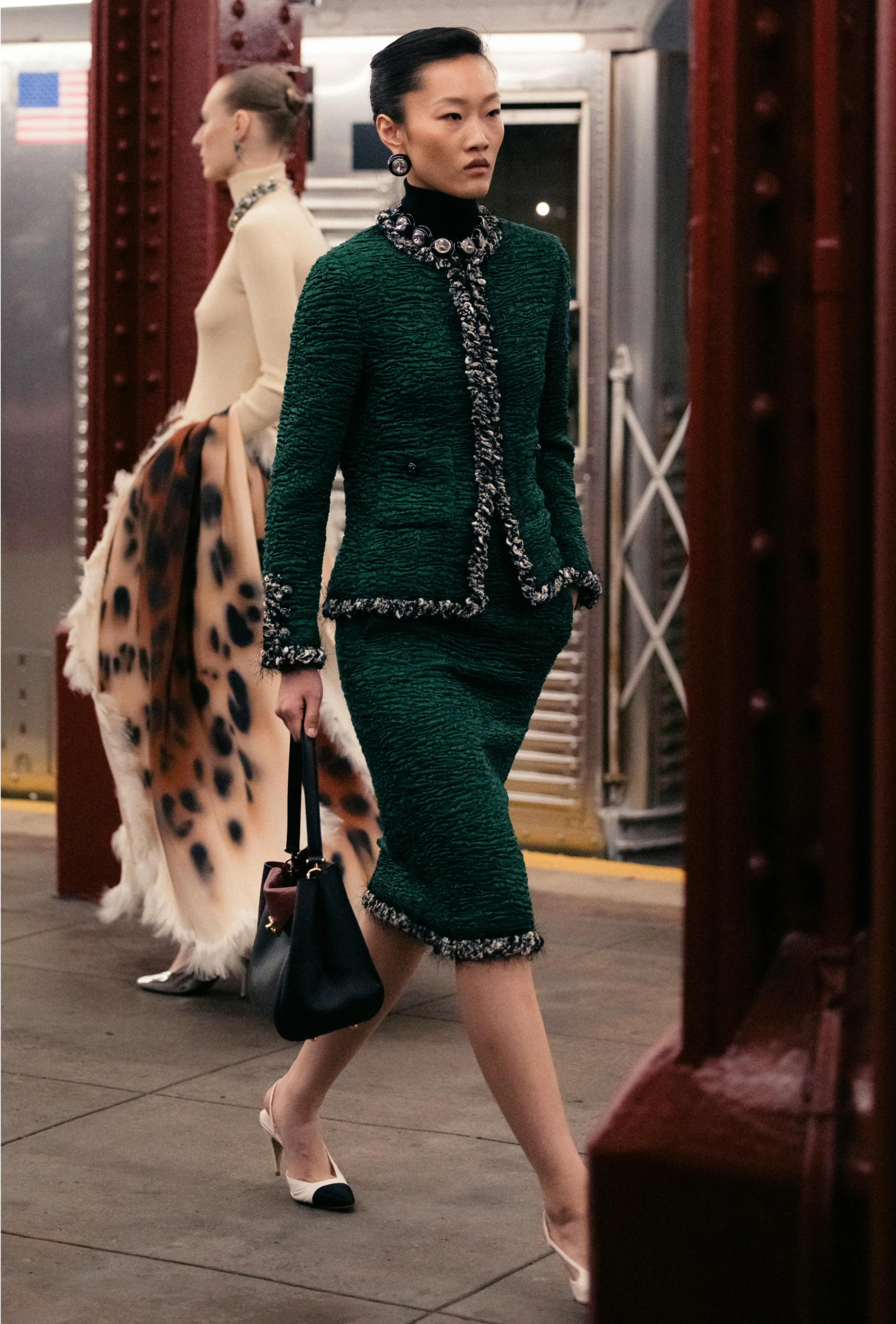
Blazy chose a decommissioned subway stop – Manhattan’s Bowery station – as the unlikely stage for Chanel’s opulent craft showcase. Beneath the city’s streets, the platform had been scrubbed spotless and dressed with vintage payphones, newsstands, and even Chanel-branded subway ephemera, transforming the gritty locale into a cinematic set. At showtime, an actual MTA train rumbled into the station and opened its doors, letting loose 80 models who spilled onto the platform in a choreographed rush. Guests perched on rows of benches built over the tracks watched as this urban theater unfolded – a spectacle of demi-couture amid metro cars and iron columns. The atmosphere evoked what Blazy called “a clash of pop archetypes” on New York’s egalitarian subway, a place where “everyone has somewhere to go and each is unique in what they wear… they are the heroes of their own stories.” The French-Belgian designer had spent several formative years living and working in New York, notably as design director under Raf Simons at Calvin Klein from 2016 to 2019, which imbued him with an appreciation for the city’s energy and eclectic style. It also echoed a famous anecdote from Chanel’s own history: in 1931, Gabrielle “Coco” Chanel visited New York en route to Hollywood and was invigorated to find local women – not all of them society ladies – imitating her Paris designs. Blazy cited this story as a spark for his Métiers d’Art 2026 concept. Much like Coco’s realization that her style had permeated all strata of society, Blazy’s New York show imagined Chanel “for the people” – without ever sacrificing the House’s hallmark luxury.
Blazy chose a decommissioned subway stop – Manhattan’s Bowery station – as the unlikely stage for Chanel’s opulent craft showcase. Beneath the city’s streets, the platform had been scrubbed spotless and dressed with vintage payphones, newsstands, and even Chanel-branded subway ephemera, transforming the gritty locale into a cinematic set. At showtime, an actual MTA train rumbled into the station and opened its doors, letting loose 80 models who spilled onto the platform in a choreographed rush. Guests perched on rows of benches built over the tracks watched as this urban theater unfolded – a spectacle of demi-couture amid metro cars and iron columns. The atmosphere evoked what Blazy called “a clash of pop archetypes” on New York’s egalitarian subway, a place where “everyone has somewhere to go and each is unique in what they wear… they are the heroes of their own stories.” The French-Belgian designer had spent several formative years living and working in New York, notably as design director under Raf Simons at Calvin Klein from 2016 to 2019, which imbued him with an appreciation for the city’s energy and eclectic style. It also echoed a famous anecdote from Chanel’s own history: in 1931, Gabrielle “Coco” Chanel visited New York en route to Hollywood and was invigorated to find local women – not all of them society ladies – imitating her Paris designs. Blazy cited this story as a spark for his Métiers d’Art 2026 concept. Much like Coco’s realization that her style had permeated all strata of society, Blazy’s New York show imagined Chanel “for the people” – without ever sacrificing the House’s hallmark luxury.
Blazy chose a decommissioned subway stop – Manhattan’s Bowery station – as the unlikely stage for Chanel’s opulent craft showcase. Beneath the city’s streets, the platform had been scrubbed spotless and dressed with vintage payphones, newsstands, and even Chanel-branded subway ephemera, transforming the gritty locale into a cinematic set. At showtime, an actual MTA train rumbled into the station and opened its doors, letting loose 80 models who spilled onto the platform in a choreographed rush. Guests perched on rows of benches built over the tracks watched as this urban theater unfolded – a spectacle of demi-couture amid metro cars and iron columns. The atmosphere evoked what Blazy called “a clash of pop archetypes” on New York’s egalitarian subway, a place where “everyone has somewhere to go and each is unique in what they wear… they are the heroes of their own stories.” The French-Belgian designer had spent several formative years living and working in New York, notably as design director under Raf Simons at Calvin Klein from 2016 to 2019, which imbued him with an appreciation for the city’s energy and eclectic style. It also echoed a famous anecdote from Chanel’s own history: in 1931, Gabrielle “Coco” Chanel visited New York en route to Hollywood and was invigorated to find local women – not all of them society ladies – imitating her Paris designs. Blazy cited this story as a spark for his Métiers d’Art 2026 concept. Much like Coco’s realization that her style had permeated all strata of society, Blazy’s New York show imagined Chanel “for the people” – without ever sacrificing the House’s hallmark luxury.
"Each is unique in what they wear… they are the heroes of their own stories."
"Each is unique in what they wear… they are the heroes of their own stories."
Courtesy of Chanel.
Courtesy of Chanel.
Courtesy of Chanel.
A Mosaic of Metropolitan Characters in Couture
A Mosaic of Metropolitan Characters in Couture
A Mosaic of Metropolitan Characters in Couture
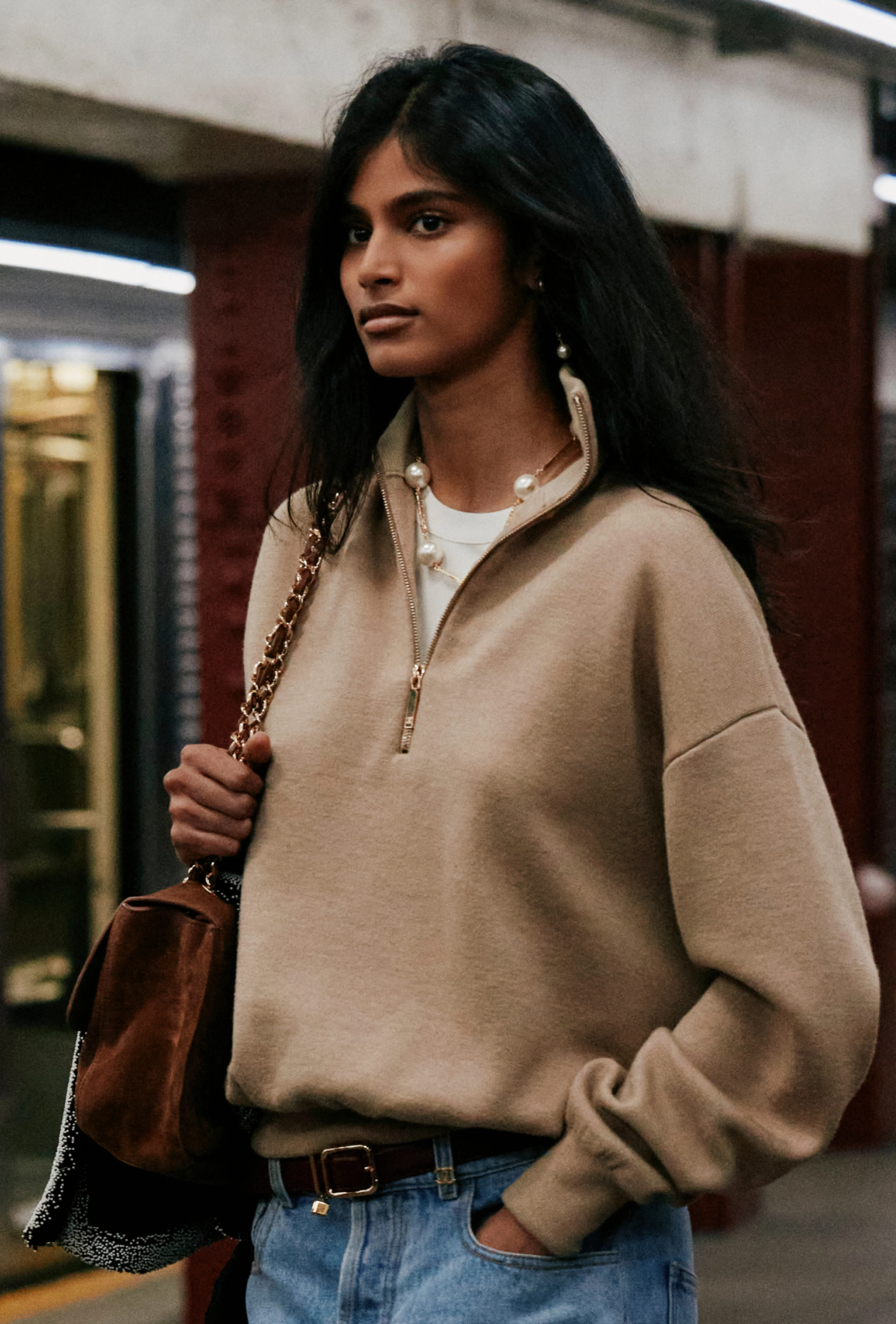
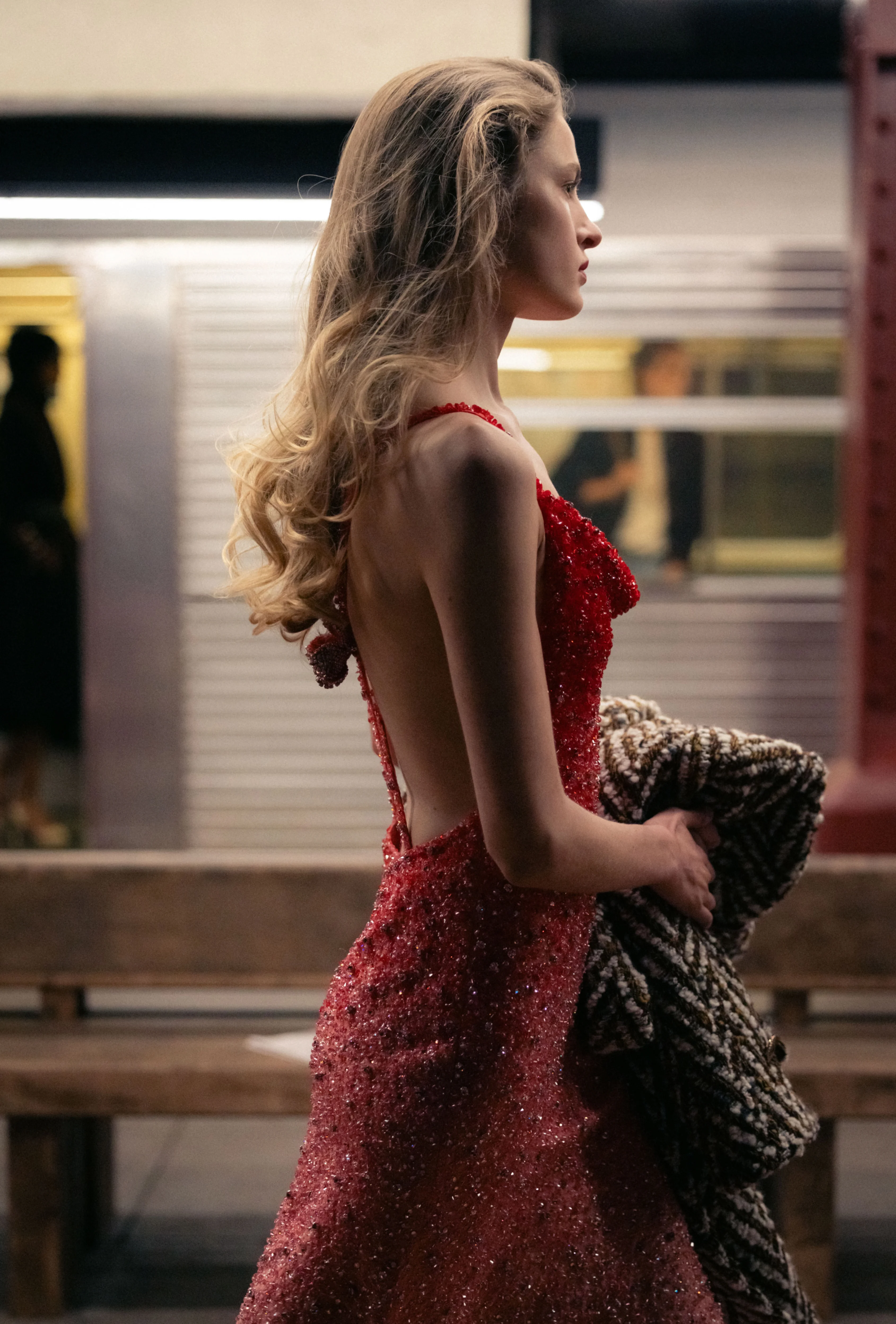
Inside the station, Blazy presented a joyful cavalcade of personalities – each look on the runway embodied a distinct New York archetype. Models did not merely walk; they played the part of classic city characters. A graduate student, portrayed by 25-year-old Bhavitha Mandava (who made history by becoming the first Indian model to open a show for Chanel), dashed by in jeans and a quarter-zip sweater, except her “jeans” were actually diaphanous silk embroidered to resemble denim, a trompe-l'œil “lingerie denim” crafted by the Lesage atelier. An elegant society doyenne floated in wearing a sweeping black opera cape over gleaming evening dress, channeling old uptown glamour. In contrast, a 1970s newsroom journalist appeared in earth-toned separates, and an ’80s power executive strode past in sharp-shouldered tailoring. One “would-be Coco” herself emerged in a fringed flapper-style frock – a cheeky 1920s nod to Chanel’s own era. There was even a taxicab-yellow skirt suit wildly speckled with animal print, a look that whimsically fused Manhattan’s hustle with Chanel’s couture codes. Blazy described his eclectic cast as a mix of “socialites and superheroes, teens and olds, working girls and showgirls, the ladies who lunch and mothers on the go” – a vibrant cross-section of city life, all reimagined through Chanel’s design vocabulary.
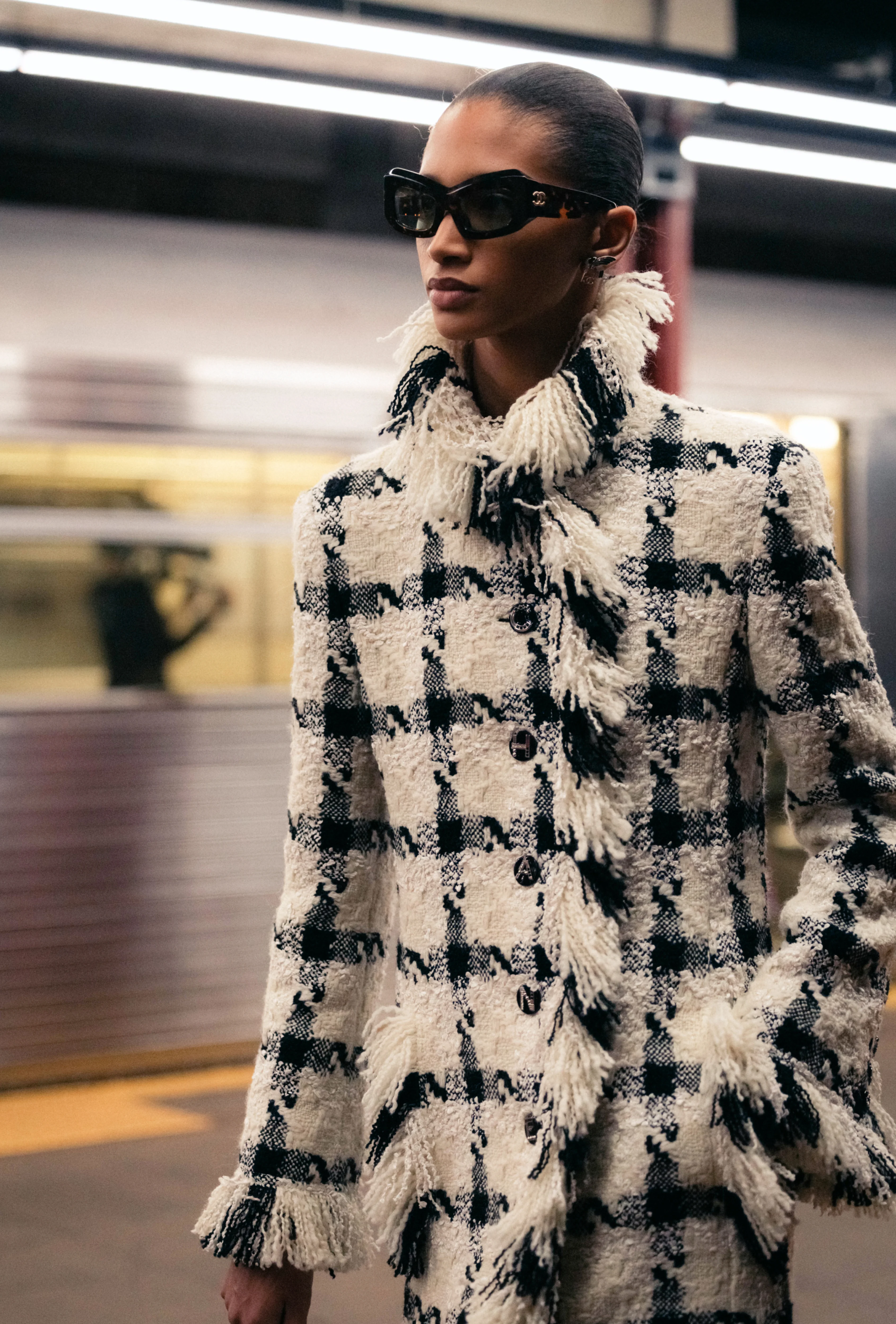
Despite the playful narrative, the clothes never descended into mere costume; this was authentic Chanel at its most inventive. Blazy’s palette spanned from classic black and ivory into bold jolts of color – taxi yellows, lipstick reds, metropolitan greys – mirroring the city’s vibrancy. Throughout the lineup, he deftly blurred the line between couture fantasy and urban reality. For instance, a look that read as a relaxed plaid flannel shirt was, in fact, meticulously loomed from bouclé tweed, elevating grunge to grand palais heights. A pair of slouchy “denim” pants turned out to be embroidered chiffon, proving that nothing was quite what it seemed in this collection. Even the show’s accessories winked at NYC iconography: one model toted a sparkling apple-shaped minaudière, while another clutched a coffee-cup evening bag – Chanel’s deluxe take on the morning commute. And for a dose of pure whimsy, an “I heart NY” motif appeared emblazoned in sequins on a classic Chanel tee, blending pop culture with artisanship. In Blazy’s hands, the venerable Chanel vocabulary – tweeds, camellias, pearls, and double-Cs – was remixed into something recognizable yet refreshingly non-uniform, a “Chanel for the people.” Yet for all its populist energy, the collection never lost the exquisite polish expected of the House, resulting in a show that felt both approachable and awe-inspiring in equal measure.
Inside the station, Blazy presented a joyful cavalcade of personalities – each look on the runway embodied a distinct New York archetype. Models did not merely walk; they played the part of classic city characters. A graduate student, portrayed by 25-year-old Bhavitha Mandava (who made history by becoming the first Indian model to open a show for Chanel), dashed by in jeans and a quarter-zip sweater, except her “jeans” were actually diaphanous silk embroidered to resemble denim, a trompe-l'œil “lingerie denim” crafted by the Lesage atelier. An elegant society doyenne floated in wearing a sweeping black opera cape over gleaming evening dress, channeling old uptown glamour. In contrast, a 1970s newsroom journalist appeared in earth-toned separates, and an ’80s power executive strode past in sharp-shouldered tailoring. One “would-be Coco” herself emerged in a fringed flapper-style frock – a cheeky 1920s nod to Chanel’s own era. There was even a taxicab-yellow skirt suit wildly speckled with animal print, a look that whimsically fused Manhattan’s hustle with Chanel’s couture codes. Blazy described his eclectic cast as a mix of “socialites and superheroes, teens and olds, working girls and showgirls, the ladies who lunch and mothers on the go” – a vibrant cross-section of city life, all reimagined through Chanel’s design vocabulary.
Despite the playful narrative, the clothes never descended into mere costume; this was authentic Chanel at its most inventive. Blazy’s palette spanned from classic black and ivory into bold jolts of color – taxi yellows, lipstick reds, metropolitan greys – mirroring the city’s vibrancy. Throughout the lineup, he deftly blurred the line between couture fantasy and urban reality. For instance, a look that read as a relaxed plaid flannel shirt was, in fact, meticulously loomed from bouclé tweed, elevating grunge to grand palais heights. A pair of slouchy “denim” pants turned out to be embroidered chiffon, proving that nothing was quite what it seemed in this collection. Even the show’s accessories winked at NYC iconography: one model toted a sparkling apple-shaped minaudière, while another clutched a coffee-cup evening bag – Chanel’s deluxe take on the morning commute. And for a dose of pure whimsy, an “I heart NY” motif appeared emblazoned in sequins on a classic Chanel tee, blending pop culture with artisanship. In Blazy’s hands, the venerable Chanel vocabulary – tweeds, camellias, pearls, and double-Cs – was remixed into something recognizable yet refreshingly non-uniform, a “Chanel for the people.” Yet for all its populist energy, the collection never lost the exquisite polish expected of the House, resulting in a show that felt both approachable and awe-inspiring in equal measure.
Inside the station, Blazy presented a joyful cavalcade of personalities – each look on the runway embodied a distinct New York archetype. Models did not merely walk; they played the part of classic city characters. A graduate student, portrayed by 25-year-old Bhavitha Mandava (who made history by becoming the first Indian model to open a show for Chanel), dashed by in jeans and a quarter-zip sweater, except her “jeans” were actually diaphanous silk embroidered to resemble denim, a trompe-l'œil “lingerie denim” crafted by the Lesage atelier. An elegant society doyenne floated in wearing a sweeping black opera cape over gleaming evening dress, channeling old uptown glamour. In contrast, a 1970s newsroom journalist appeared in earth-toned separates, and an ’80s power executive strode past in sharp-shouldered tailoring. One “would-be Coco” herself emerged in a fringed flapper-style frock – a cheeky 1920s nod to Chanel’s own era. There was even a taxicab-yellow skirt suit wildly speckled with animal print, a look that whimsically fused Manhattan’s hustle with Chanel’s couture codes. Blazy described his eclectic cast as a mix of “socialites and superheroes, teens and olds, working girls and showgirls, the ladies who lunch and mothers on the go” – a vibrant cross-section of city life, all reimagined through Chanel’s design vocabulary.
Despite the playful narrative, the clothes never descended into mere costume; this was authentic Chanel at its most inventive. Blazy’s palette spanned from classic black and ivory into bold jolts of color – taxi yellows, lipstick reds, metropolitan greys – mirroring the city’s vibrancy. Throughout the lineup, he deftly blurred the line between couture fantasy and urban reality. For instance, a look that read as a relaxed plaid flannel shirt was, in fact, meticulously loomed from bouclé tweed, elevating grunge to grand palais heights. A pair of slouchy “denim” pants turned out to be embroidered chiffon, proving that nothing was quite what it seemed in this collection. Even the show’s accessories winked at NYC iconography: one model toted a sparkling apple-shaped minaudière, while another clutched a coffee-cup evening bag – Chanel’s deluxe take on the morning commute. And for a dose of pure whimsy, an “I heart NY” motif appeared emblazoned in sequins on a classic Chanel tee, blending pop culture with artisanship. In Blazy’s hands, the venerable Chanel vocabulary – tweeds, camellias, pearls, and double-Cs – was remixed into something recognizable yet refreshingly non-uniform, a “Chanel for the people.” Yet for all its populist energy, the collection never lost the exquisite polish expected of the House, resulting in a show that felt both approachable and awe-inspiring in equal measure.
Courtesy of Chanel.
Courtesy of Chanel.
Courtesy of Chanel.
Courtesy of Chanel.
Courtesy of Chanel.
Courtesy of Chanel.
Haute Craftsmanship: Métiers d’Art in Every Detail
Haute Craftsmanship: Métiers d’Art in Every Detail
Haute Craftsmanship: Métiers d’Art in Every Detail
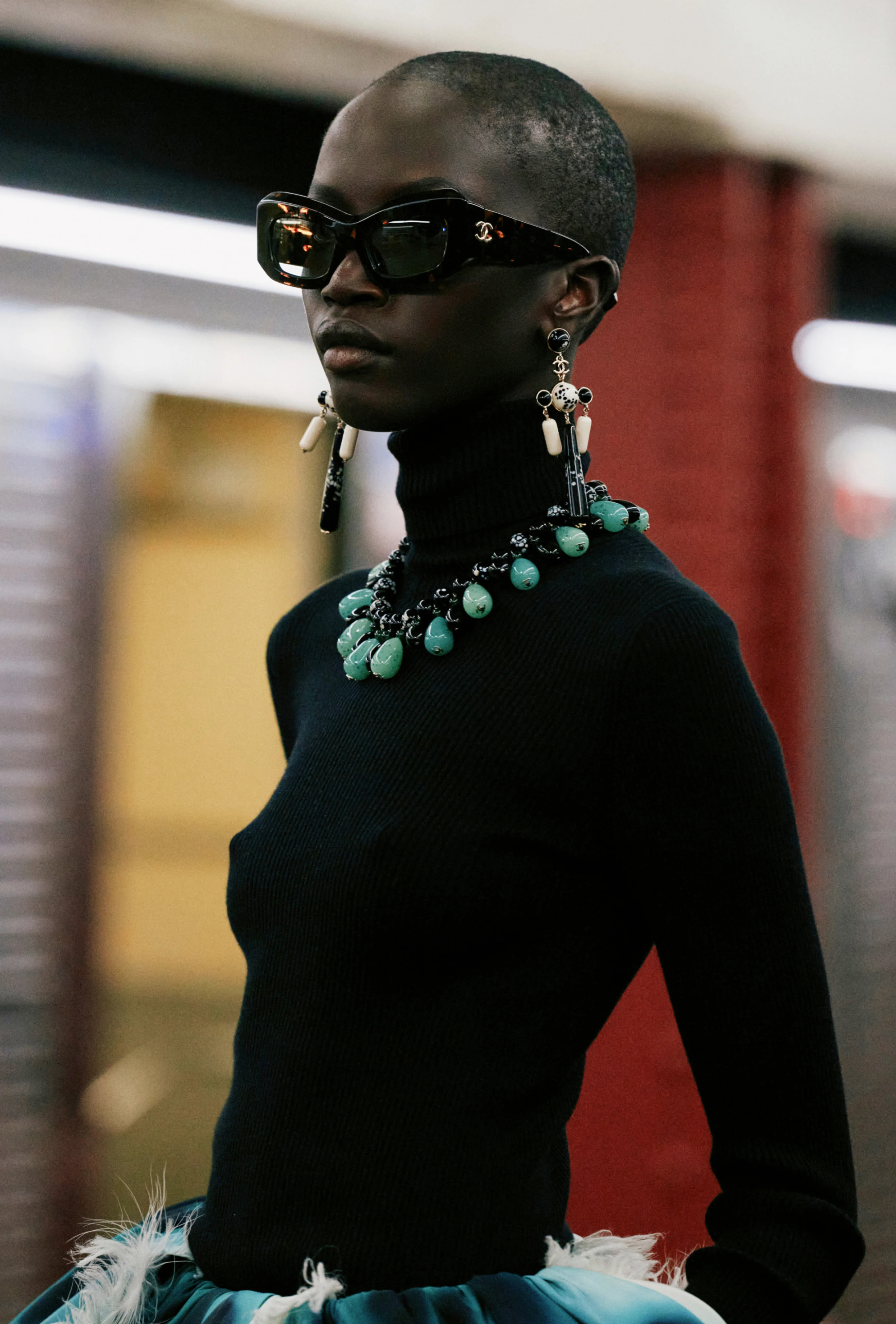
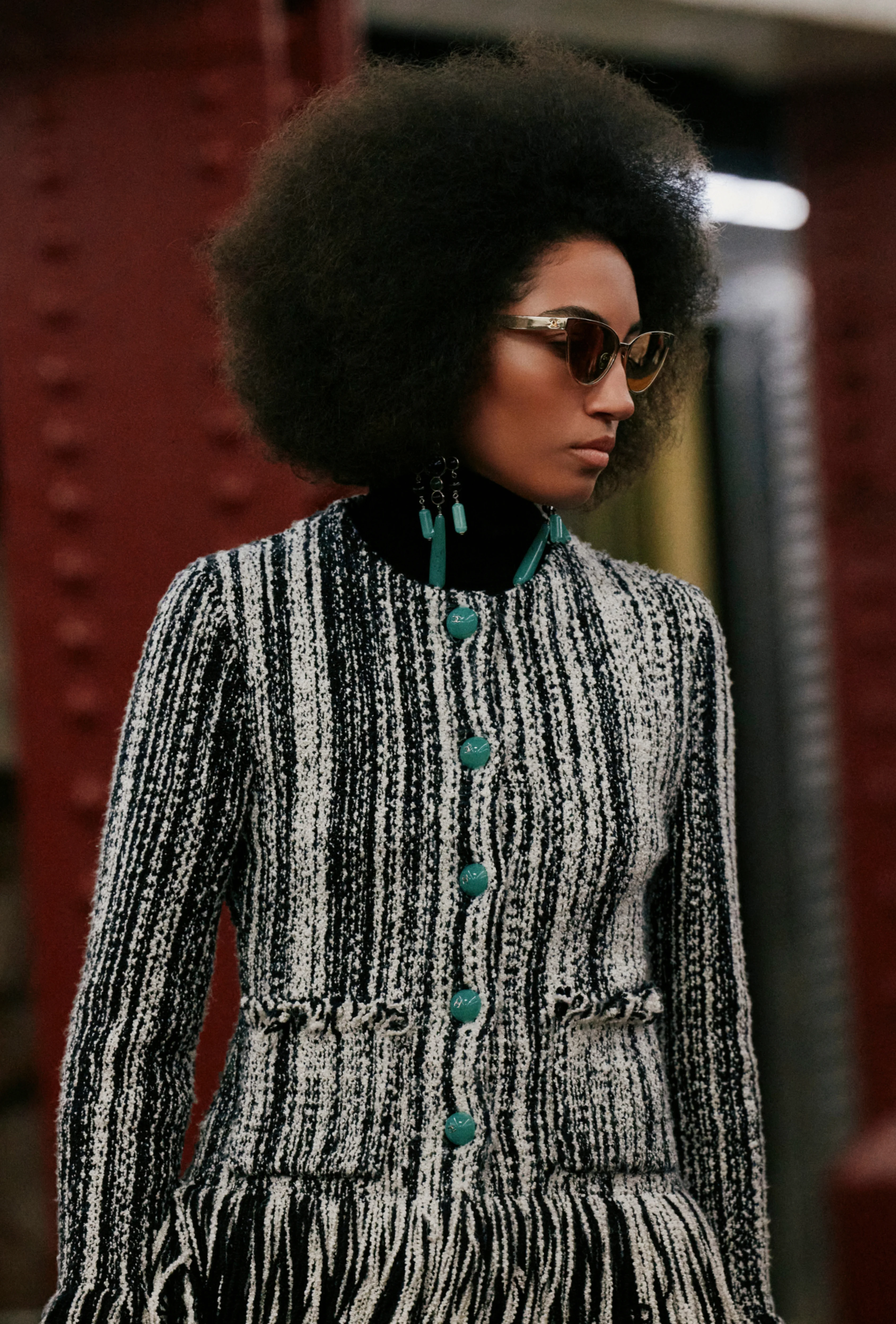
At the heart of the Métiers d’Art 2026 collection was, as always, an astonishing display of craftsmanship, spotlighting the artisans of Chanel’s specialist workshops. Every ensemble, no matter how streetwise or whimsical, was built upon laborious savoir-faire. Blazy’s subway dreamscape thus doubled as a live exhibition of what Chanel’s métiers d’art can achieve, as is the beauty of each year’s iteration of the collection. A standout example was a tweed suit in bold leopard print – its fabric was hand-woven by Lesage, the legendary embroidery and tweed atelier, imbuing a wild pop-art pattern with couture refinement. One moment, models appeared in deceptively simple knitwear and denim; look closer, and constellations of beads twinkled on ultra-light silk “jeans” and an interlocking-C Superman logo peeked from a sweater beneath a ripped-open shirt – playful touches courtesy of the embroidery studios. Evening looks brought further marvels: Lemarié, Chanel’s feather and floral expert, lent magic to billowing tulle “tulip” skirts hand-painted and edged with delicate feathers, and to the marabou-plumed heels that accompanied them. The millinery maestros at Maison Michel created sheer net veils and cloche hats that topped off several outfits, giving a retro-chic allure to the models’ New York stroll. In accessories, the goldsmiths of Goossens contributed gilded costume jewelry with a witty twist – chunky necklaces and earrings shaped like ice cubes and tiny hummingbirds, glinting under the station lights. Massaro, Chanel’s historic shoemaker, reimagined the House’s iconic two-tone slingback shoe in luxurious new guises – from featherweight kidskin leather to audacious shaved shearling printed in animal spots. Even seemingly workaday pieces were touched by artisanal mastery: jeweled buttons and charms crafted by Desrues adorned jacket fronts, while precise pleats on flowing skirts quietly heralded the handiwork of the Lognon pleating atelier. It is precisely this fusion of supreme craftsmanship with design that defines the Métiers d’Art ethos. Chanel’s Métiers d’Art collections are unique in the fashion world – introduced by Lagerfeld in 2002 as an annual ode to the artisans – and Blazy’s New York edition upheld that legacy with bravura.
At the heart of the Métiers d’Art 2026 collection was, as always, an astonishing display of craftsmanship, spotlighting the artisans of Chanel’s specialist workshops. Every ensemble, no matter how streetwise or whimsical, was built upon laborious savoir-faire. Blazy’s subway dreamscape thus doubled as a live exhibition of what Chanel’s métiers d’art can achieve, as is the beauty of each year’s iteration of the collection. A standout example was a tweed suit in bold leopard print – its fabric was hand-woven by Lesage, the legendary embroidery and tweed atelier, imbuing a wild pop-art pattern with couture refinement. One moment, models appeared in deceptively simple knitwear and denim; look closer, and constellations of beads twinkled on ultra-light silk “jeans” and an interlocking-C Superman logo peeked from a sweater beneath a ripped-open shirt – playful touches courtesy of the embroidery studios. Evening looks brought further marvels: Lemarié, Chanel’s feather and floral expert, lent magic to billowing tulle “tulip” skirts hand-painted and edged with delicate feathers, and to the marabou-plumed heels that accompanied them. The millinery maestros at Maison Michel created sheer net veils and cloche hats that topped off several outfits, giving a retro-chic allure to the models’ New York stroll. In accessories, the goldsmiths of Goossens contributed gilded costume jewelry with a witty twist – chunky necklaces and earrings shaped like ice cubes and tiny hummingbirds, glinting under the station lights. Massaro, Chanel’s historic shoemaker, reimagined the House’s iconic two-tone slingback shoe in luxurious new guises – from featherweight kidskin leather to audacious shaved shearling printed in animal spots. Even seemingly workaday pieces were touched by artisanal mastery: jeweled buttons and charms crafted by Desrues adorned jacket fronts, while precise pleats on flowing skirts quietly heralded the handiwork of the Lognon pleating atelier. It is precisely this fusion of supreme craftsmanship with design that defines the Métiers d’Art ethos. Chanel’s Métiers d’Art collections are unique in the fashion world – introduced by Lagerfeld in 2002 as an annual ode to the artisans – and Blazy’s New York edition upheld that legacy with bravura.
At the heart of the Métiers d’Art 2026 collection was, as always, an astonishing display of craftsmanship, spotlighting the artisans of Chanel’s specialist workshops. Every ensemble, no matter how streetwise or whimsical, was built upon laborious savoir-faire. Blazy’s subway dreamscape thus doubled as a live exhibition of what Chanel’s métiers d’art can achieve, as is the beauty of each year’s iteration of the collection. A standout example was a tweed suit in bold leopard print – its fabric was hand-woven by Lesage, the legendary embroidery and tweed atelier, imbuing a wild pop-art pattern with couture refinement. One moment, models appeared in deceptively simple knitwear and denim; look closer, and constellations of beads twinkled on ultra-light silk “jeans” and an interlocking-C Superman logo peeked from a sweater beneath a ripped-open shirt – playful touches courtesy of the embroidery studios. Evening looks brought further marvels: Lemarié, Chanel’s feather and floral expert, lent magic to billowing tulle “tulip” skirts hand-painted and edged with delicate feathers, and to the marabou-plumed heels that accompanied them. The millinery maestros at Maison Michel created sheer net veils and cloche hats that topped off several outfits, giving a retro-chic allure to the models’ New York stroll. In accessories, the goldsmiths of Goossens contributed gilded costume jewelry with a witty twist – chunky necklaces and earrings shaped like ice cubes and tiny hummingbirds, glinting under the station lights. Massaro, Chanel’s historic shoemaker, reimagined the House’s iconic two-tone slingback shoe in luxurious new guises – from featherweight kidskin leather to audacious shaved shearling printed in animal spots. Even seemingly workaday pieces were touched by artisanal mastery: jeweled buttons and charms crafted by Desrues adorned jacket fronts, while precise pleats on flowing skirts quietly heralded the handiwork of the Lognon pleating atelier. It is precisely this fusion of supreme craftsmanship with design that defines the Métiers d’Art ethos. Chanel’s Métiers d’Art collections are unique in the fashion world – introduced by Lagerfeld in 2002 as an annual ode to the artisans – and Blazy’s New York edition upheld that legacy with bravura.
Courtesy of Chanel.
Courtesy of Chanel.
Courtesy of Chanel.
Courtesy of Chanel.
Courtesy of Chanel.
Courtesy of Chanel.
A New Chapter in Motion
A New Chapter in Motion
A New Chapter in Motion
The debut Chanel Métiers d’Art collection of Matthieu Blazy proved to be a valiant step on the journey upon which the House’s new creative director is embarking. It marks a collection that upholds Chanel’s artisanal heritage while exploring how those traditions can inhabit new contexts. Through the dialogue created between the exclusive nature of luxury and the diverse, everyday sources of its inspiration, Blazy suggests that these worlds need not exist in separate spheres but can instead coexist with clarity and intent. And with his past remarks on reshaping Chanel “from a panoply, a costume… into a wardrobe,” Blazy moves closer to that premise, offering an early articulation of a Chanel that honors its past while engaging with its future. It is a trajectory less concerned with reinvention for its own sake than with articulating the House’s identity in ways that resonate across contexts, positioning its métiers as instruments for interpreting contemporary life rather than preserving static ideals to reach outcomes attuned to the evolving world it dresses.
The debut Chanel Métiers d’Art collection of Matthieu Blazy proved to be a valiant step on the journey upon which the House’s new creative director is embarking. It marks a collection that upholds Chanel’s artisanal heritage while exploring how those traditions can inhabit new contexts. Through the dialogue created between the exclusive nature of luxury and the diverse, everyday sources of its inspiration, Blazy suggests that these worlds need not exist in separate spheres but can instead coexist with clarity and intent. And with his past remarks on reshaping Chanel “from a panoply, a costume… into a wardrobe,” Blazy moves closer to that premise, offering an early articulation of a Chanel that honors its past while engaging with its future. It is a trajectory less concerned with reinvention for its own sake than with articulating the House’s identity in ways that resonate across contexts, positioning its métiers as instruments for interpreting contemporary life rather than preserving static ideals to reach outcomes attuned to the evolving world it dresses.
The debut Chanel Métiers d’Art collection of Matthieu Blazy proved to be a valiant step on the journey upon which the House’s new creative director is embarking. It marks a collection that upholds Chanel’s artisanal heritage while exploring how those traditions can inhabit new contexts. Through the dialogue created between the exclusive nature of luxury and the diverse, everyday sources of its inspiration, Blazy suggests that these worlds need not exist in separate spheres but can instead coexist with clarity and intent. And with his past remarks on reshaping Chanel “from a panoply, a costume… into a wardrobe,” Blazy moves closer to that premise, offering an early articulation of a Chanel that honors its past while engaging with its future. It is a trajectory less concerned with reinvention for its own sake than with articulating the House’s identity in ways that resonate across contexts, positioning its métiers as instruments for interpreting contemporary life rather than preserving static ideals to reach outcomes attuned to the evolving world it dresses.
Courtesy of Chanel.
Courtesy of Chanel.
Courtesy of Chanel.
Since 1985, Chanel has gradually acquired their 11 specialist métiers d’art – rangning from embroiderers and feather-makers to milliners, pleaters, button-makers, goldsmiths and shoemakers – to ensure their exceptional skills endure into the future. At le19M (named for the 19th arrondissement and for modes, mains, métiers), around 700 artisans practice time-honored techniques in embroidery, featherwork, pleating, jewelry, and more, often collaborating to push the boundaries of couture creativity. The Métiers d’Art show is their moment to shine. As Bruno Pavlovsky, Chanel’s fashion president, has noted, these annual collections serve to “foster dialogue between different crafts to nurture new ideas” and keep the artisan heritage alive.
Since 1985, Chanel has gradually acquired their 11 specialist métiers d’art – rangning from embroiderers and feather-makers to milliners, pleaters, button-makers, goldsmiths and shoemakers – to ensure their exceptional skills endure into the future. At le19M (named for the 19th arrondissement and for modes, mains, métiers), around 700 artisans practice time-honored techniques in embroidery, featherwork, pleating, jewelry, and more, often collaborating to push the boundaries of couture creativity. The Métiers d’Art show is their moment to shine. As Bruno Pavlovsky, Chanel’s fashion president, has noted, these annual collections serve to “foster dialogue between different crafts to nurture new ideas” and keep the artisan heritage alive.
Since 1985, Chanel has gradually acquired their 11 specialist métiers d’art – rangning from embroiderers and feather-makers to milliners, pleaters, button-makers, goldsmiths and shoemakers – to ensure their exceptional skills endure into the future. At le19M (named for the 19th arrondissement and for modes, mains, métiers), around 700 artisans practice time-honored techniques in embroidery, featherwork, pleating, jewelry, and more, often collaborating to push the boundaries of couture creativity. The Métiers d’Art show is their moment to shine. As Bruno Pavlovsky, Chanel’s fashion president, has noted, these annual collections serve to “foster dialogue between different crafts to nurture new ideas” and keep the artisan heritage alive.
More Stories
More Stories
More Stories